- AdQuick Newsletter
- Posts
- When the Pipes Change Shape
When the Pipes Change Shape
What DSP/SSP Convergence Means for a Nine-and-a-Half-Billion-Dollar Industry That Still Mostly Runs on Phone Calls

AdQuick
April 10, 2026
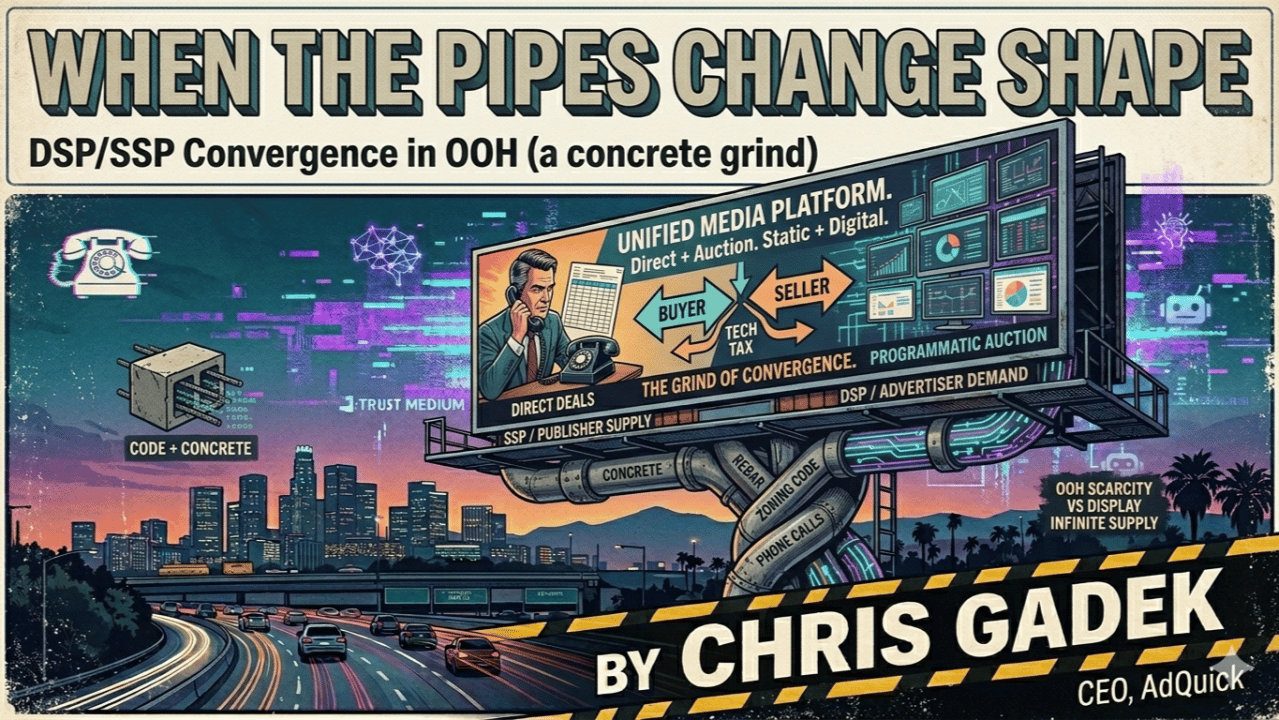
There is a thesis circulating in the adtech industry that goes, more or less, like this: the traditional separation between the platforms that help advertisers buy ads and the platforms that help publishers sell ads is collapsing, and the result will be a world with fewer intermediaries, shorter supply chains, and perhaps ten to fifteen global transaction platforms where there used to be hundreds. The thesis is laid out methodically in a research report by Karsten Weide of W Media Research called “When DSPs and SSPs Converge,” and it is persuasive in the way that structural analyses of mature industries tend to be persuasive. You read it, you nod, you understand the forces at work, and you can more or less see where it is going. It has the kind of explanatory clarity that makes you feel slightly smarter for having encountered it, which is always a warning sign.
But here is what makes the thesis interesting instead of merely only correct: it was written about the internet.
About display ads and connected television and real-time bidding auctions that happen in milliseconds across entirely virtual infrastructure. And now the same logic, the same economic forces, the same consolidation dynamics, the same acronyms, is being applied to an advertising medium that involves, in many cases, physically bolting a piece of steel to a concrete foundation next to a highway and then hiring someone to glue vinyl to it.
This is the story of what happens when the most sophisticated supply-chain engineering in modern advertising tries to optimize something that is stubbornly, irreducibly, almost comically physical. It is a story about software eating the world and discovering that some parts of the world are made of rebar and municipal zoning code, and that the interesting question is not whether convergence will arrive in out-of-home advertising (it will, it is) but what convergence becomes when it encounters a medium that exists in three-dimensional space, is regulated by municipal zoning boards, and measures its audiences by modeling who probably walked or drove past a sign rather than tracking who clicked on it.
The answer, it turns out, tells you something about how industries actually change, which is almost never the way the people driving the change think it will happen. It is also almost never as clean.
The Landscape, or: A $9.46 Billion Market That Is Somehow Both Booming and Underperforming
The first thing you need to understand about out-of-home advertising in 2026 is that it is growing and that it is not growing fast enough, and that both of these things are true at the same time in a way that would be paradoxical in most industries but makes perfect sense once you understand the structural dynamics.
U.S. OOH ad revenue hit a record $9.46 billion in 2025, up 3.6 percent year-over-year, extending the industry’s streak to nineteen consecutive quarters of growth.(1) Digital OOH accounted for 36.3 percent of total revenue and grew 10.5 percent.(1) Transit was the fastest-growing format at 9.2 percent.(1) By any normal standard, this is a healthy industry.
But OOH’s share of total U.S. media spend has declined from roughly four percent to about two and a half percent over the past decade, while comparable markets (Germany at nine percent, Australia climbing from four to six percent) are going the other direction. This is not a demand problem. The OAAA and Winterberry Group found in March 2026 that ninety-eight percent of marketers view OOH as a core or supporting component of their connected commerce strategies, and eighty-six percent plan to increase investment.(2) Ninety-eight percent. That is not a majority. That is a consensus, which in the advertising industry is approximately as rare as a humble holding company. The demand exists. What does not yet exist, or exists only in incomplete and fragmented form, is the infrastructure to capture it at the pace and scale that modern media buying requires.
And this is where the convergence thesis enters the picture. Not as an abstract trend happening to somebody else’s industry, but as the specific set of structural changes that will determine whether OOH closes the gap between what it delivers and what it captures, or whether it continues to grow in absolute terms while slowly becoming less relevant in comparative terms. Which is a polite way of saying: winning while losing.
The OOH market is not one market. There are at least six markets wearing a trenchcoat, and the convergence story applies differently to each of them.
There are large-format roadside billboards, which are the thing most people picture when you say “out-of-home advertising.” The static ones, vinyl posters and painted bulletins, still constitute roughly fifty-seven percent of billboard faces in the U.S.(3) The digital ones constitute fewer than seven percent of Clear Channel Outdoor’s faces but generate forty-six percent of its revenue,(3) which is a ratio that tells you everything you need to know about where the economics are pointing. Seven percent of the physical assets producing forty-six percent of the economic value. That is not a trend. That is a verdict.
There is transit: subway stations, bus shelters, commuter rail, airport concourses. It is the fastest-growing OOH segment(1) and the one most shaped by the concession model, where public transit agencies award long-term contracts to operators like OUTFRONT Media and Intersection Co. , and where digital transit ads doubled their share of the transit category from eighteen percent to thirty-six percent between 2022 and 2023.(4) Doubled. In two years. While most of the OOH industry was still arguing about whether programmatic was a fad.
There is place-based (malls, airports, health clubs, bars, cinema, gas stations, EV chargers, elevators), which is the most fragmented segment and the one with the least standardized measurement.
There is street furniture (bus shelters, kiosks, benches), which is governed by municipal concession contracts and is dominated globally by JCDecaux’s concession relationships.(5)
There is mobility OOH: rideshare toppers, vehicle wraps, truck-sides, LED mobile billboards. It is the format that most thoroughly undermines the static-versus-digital binary, because a rideshare car with a Firefly digital top(6) and a Good Traffic (fka Mobilads) vinyl wrap is both static and digital, simultaneously, on a single moving platform.
And there are spectaculars and experiential: Times Square installations, a Zoom lunch popup, the Sphere Entertainment Co. in Las Vegas, building projections, station dominations that cost fifty thousand to a hundred and fifty thousand pounds per month in central London.(8) These are bought as custom packages on long lead times and priced on brand impact rather than CPM, and they exist so far outside the programmatic paradigm that applying the convergence thesis to them is a bit like applying aerodynamic theory to a brick. You can do it. The brick does not care.
Then there is the transaction layer, which cuts across all of these formats. Fifty-nine percent of marketers still rely on direct deals for OOH buying.(9) Programmatic guaranteed, which is software-mediated but not auction-based, is the fastest-growing transaction type. Private marketplace deals are expanding. And open real-time bidding accounts for eight to twelve percent of global DOOH transactions,(10) growing at a seventeen to twenty percent compound annual rate(11) but still representing a single-digit share of the overall market. If programmatic DOOH were a political candidate, it would be the one everyone describes as “surging” while receiving nine percent of the vote.
The convergence story in OOH is happening on all of these layers simultaneously. But it is happening on two fundamentally different planes, one made of software and one made of steel and concrete, and the interaction between those two planes is where things get genuinely interesting.
The Physical Plane, or: Why a $200,000 Capital Investment and a Municipal Zoning Board Are the Real Engines of Change
The conventional convergence narrative, the one that works well for display advertising and connected television, is primarily a software story. Platforms merge. Supply chains shorten. Intermediary fees compress. Data flows consolidate. It all happens in code, and the relevant timescale is months, not years.
OOH has a version of this story, and we will get to it. But OOH also has a convergence that no other advertising channel has, one that operates in the physical world with physical economics and physical constraints. It is the process by which a static billboard becomes a digital billboard, and it is happening at a pace that is determined not by the readiness of any technology platform but by the willingness of municipal planning commissions to issue permits.
The economics are almost absurdly compelling. On a February 2025 earnings call, Lamar Advertising Company CEO Sean Reilly broke down the conversion math publicly: a static billboard averaging three thousand dollars a month in revenue is replaced by a digital unit costing roughly two hundred thousand dollars, and the revenue jumps to approximately fifteen thousand dollars a month. That is a five-to-six-times lift.(12) SignValue’s independent analysis puts the return on capital at forty-three percent under Lamar’s assumptions and thirty-two percent under more conservative ones. A small-market ten-by-thirty conversion still generates twenty-four percent.(13) Comsight Display, analyzing disclosures from all three major operators, finds that digital units generate three to eight times more revenue per location with payback in eighteen to thirty-six months.(14)
Private equity has noticed.(15) Private equity always notices a forty-three percent return on capital. Digital assets command substantially higher valuations than static in M&A transactions.(16) Clear Channel, Lamar, and Outfront are all converting static faces to LED as a significant part of their growth strategy.
Here is the nuance that most coverage of this trend misses: the economics are driven by multi-tenant rotation, not by programmatic revenue. When you convert a static billboard to digital, you go from selling one ad slot to selling eight. Each of those eight advertisers pays a large percentage of roughly what the single static advertiser paid, so total revenue multiplies. This is straightforward real estate economics. You are not building programmatic infrastructure; you are subdividing a single-tenant property into a multi-tenant one. The technology is incidental. The spreadsheet is the point. The conversion math works entirely on direct sales. Programmatic revenue is additive, filling the last unsold slots in the rotation, but it is not what justifies the two-hundred-thousand-dollar capital expenditure.
This matters because it means the physical conversion pipeline operates independently of the programmatic convergence pipeline. Static billboards are becoming digital billboards because the real estate math is good, and once they are digital, they can enter the programmatic ecosystem, but they do not need to enter it to be profitable. The physical plane feeds the software plane from below, creating inventory that the programmatic platforms can then transact, measure, and optimize. The causality runs uphill. Most people assume it runs the other way, which is why most people are wrong about the sequencing of this transformation.
Now here is where the story acquires its distinctive character, the thing that separates OOH convergence from every other convergence narrative in advertising and that makes it, I think, genuinely philosophically interesting.
The physical conversion has a bottleneck, and the bottleneck is zoning.
Converting a static billboard to digital is typically treated as a new placement requiring a new permit.(17) This is not a technicality. It is the single largest constraint on how fast the OOH industry can create new programmatic inventory, and it is governed by a three-tier regulatory framework:(18) federal (the Highway Beautification Act of 1965, a piece of legislation that Lyndon B. Johnson signed and that is still determining the pace of advertising innovation sixty-one years later), state (in California, the Outdoor Advertising Act and Caltrans permitting), and municipal (zoning ordinances that vary wildly from city to city).
The municipal layer is where the variability becomes surreal. Some cities treat digital billboards more restrictively than static. Others favor digital and prohibit static.(17) Some maintain complete billboard moratoriums. Permit fees range from one hundred dollars to ten thousand dollars annually (not including the survey and engineering costs required for permits).(18) Digital-specific concerns include brightness, light pollution, driver distraction, glare, and environmental impact, each of which can trigger its own review process. Three digital boards within a mile can suppress pricing for all of them,(16) particularly the one in the middle, which means operators have to evaluate not just their own board’s economics but the competitive geometry of the entire corridor.
The implication is delicious if you are the kind of person who finds irony in industrial dynamics. The pace at which the most advanced advertising supply-chain engineering can acquire new inventory is gated by the deliberations of municipal zoning boards in mid-sized American cities. You can build a real-time bidding platform in six months. You cannot change a zoning ordinance in six months. In some jurisdictions, you cannot change it at all. The convergence thesis, which is at its core a thesis about software efficiency, is encountering a physical constraint that software cannot optimize away. The billboard must be bolted to something. The something must be zoned for it. And the zoning is up to a planning commission that meets on the second Tuesday of each month and has other things on its agenda.
This is not a failure of the convergence thesis. It is a feature of OOH that makes the convergence story structurally different from every other channel. And it is the reason that a meaningful portion of OOH will remain static, remain direct-sold, remain measured by traffic models rather than impression trackers, for a long time. Not because the industry is backward, but because the physical world does not convert on a software deployment schedule.
What Stays Static, and What That Means
Not everything converts immediately. Not everything should.
A static billboard offers something no digital display can replicate: one hundred percent share of voice. One advertiser, twenty-four hours a day, for the entire contract. There is no rotation, no competing message, no eight-second cycle. Nielsen data shows eighty-three percent message recall for digital billboards versus sixty-five percent for static,(19) but recall measured on a single-exposure basis misses the point. Static’s value is cumulative. You see the same board every morning on your commute, and after three weeks, it stops being an advertisement and starts being a fact about the world. That is a different kind of advertising from a flexible, targeted, real-time-optimized digital display, and there are campaigns (local brand embedding, long-term awareness, political) for which it is the better format.
A vinyl bus wrap embeds a brand in the texture of a neighborhood.(20) A wallscape transforms a building facade into a landmark. A station domination in the London Underground is not a media buy. It is an act of territorial assertion, and it costs fifty thousand to a hundred and fifty thousand pounds a month(8) because it is an experience that no digital display unit, no matter how programmatically optimized, can replicate. Try buying a “station domination” through a DSP. You will discover that some things were not designed to be transacted in milliseconds.
These formats resist convergence not because they are obsolete but because their value proposition is inherently non-programmable. They are exclusive, physical, culturally embedded, and priced on brand impact rather than CPM efficiency. The convergence thesis does not need them to converge. It needs the platforms, the measurement systems, and the buying workflows to accommodate them alongside the formats that do converge, so that a buyer can plan a campaign that includes a static billboard, a programmatic transit screen, and a station domination in the same workflow, measured by the same system, managed through the same platform.
This is a more interesting and more honest version of the convergence thesis than the one that says everything becomes programmatic. Some things do not become programmatic. Some things become programmatic-adjacent: transacted through software but not through auctions, measured by audience models rather than impression trackers, bought on relationships and creativity rather than real-time optimization. The convergence that matters in OOH is not “everything goes to auction.” It is “every transaction flows through software.” That is a subtle but consequential distinction.
The Bridge Problem, or: How You Measure Something That Exists in Three-Dimensional Space
If the physical conversion pipeline creates the inventory and the programmatic convergence creates the transaction layer, then measurement is the bridge between them. And the bridge is, at present, incomplete.
Geopath, the not-for-profit organization that provides industry-standard audience metrics for OOH, constructs its ratings using mobile device trip data from hundreds of millions of devices and connected cars, INRIX traffic speed data, eye-tracking research, and demographic modeling from census data.(21) The system works across static and digital: it measures the audience for the physical location regardless of what is on the screen. It maps each display’s position relative to the roadway, calculates traffic volume, allocates that traffic by hour and day, applies visibility adjustments for road type and display size and speed of passage, factors in eye-tracking probabilities, and produces an audience count. It is methodologically serious work, and it covers roadside, transit, and (via a pilot program(22)) an expanding set of place-based venues.
But it is probabilistic. OOH measurement models who likely saw an ad. Digital measurement tracks who did see an ad (or at least who received the impression event; whether they actually saw it is a separate problem that digital advertising prefers not to discuss in polite company, in the same way that a restaurant prefers not to discuss what happens in the kitchen). This distinction is why OOH gets excluded from omnichannel media mix models. Not because OOH is unmeasurable, but because its measurement speaks a different language than the measurement of every other channel, and nobody has yet built a reliable translator.
The IAB released a comprehensive DOOH Measurement Guide in 2025:(23) shared definitions for impressions (“Opportunity to See” versus “Likelihood to See”), audience metrics, viewability standards, attribution models, cross-channel integration requirements. Geopath’s place-based pilot is extending measurement to venues where it has not historically existed. The CEO of Eye Corp, speaking about the pilot, articulated the core problem as clearly as anyone has: “The entire OOH ecosystem needs a trusted, universal currency.”(22)
There is also a transparency gap worth noting. No ISBA/PwC-style forensic supply chain audit has been conducted on the OOH supply chain, the kind that, when applied to UK digital programmatic, found that only fifty-one percent of advertiser spend reaches publishers and fifteen percent is entirely unaccounted for.(24) This is a credibility problem for OOH, but it is also an interesting asymmetry: the digital audits uncovered enormous waste and opacity. OOH’s supply chain almost certainly does not have the same magnitude of waste problem. Its transparency deficit is about measurement methodology, not about money evaporating into unknown intermediaries. Running the audit and proving this would be, arguably, the single most powerful competitive move the OOH industry could make. The fact that nobody has done it yet tells you something about the industry’s instinct for self-promotion, which is to say it does not have one.
Meanwhile, something genuinely novel is happening at the boundary of physical and digital measurement. GOOD TRAFFIC (formerly mobilads), which operates rideshare car-wrap campaigns across more than five hundred U.S. cities and Mexico for over seventy-five Fortune 1000 clients,(7) collects first-party GPS data every few seconds from its vehicles and combines it with third-party mobile location data to determine who was in viewing distance of the ads. The company measures outcomes including foot traffic lift (via geofencing) and online conversions (via pixel), and visualizes campaign coverage through heat maps and a real-time reporting dashboard. CEO Craig Andrew Cook has described the format as “moment-based OOH” that supplements existing media strategy, and the company routinely launches hundred-plus vehicle campaigns in major markets within three to seven days of receiving artwork.(43) It is a static, non-digital, vinyl-on-a-car advertising surface generating data that directly feeds measurable outcomes. If you wanted a single example of how the physical plane and the software plane connect, this is it. The vinyl wrap does not change. The data it generates does.
And the standardization initiative that Wrapify, Firefly, and mobilads (now Good Traffic) co-led in January 2023, which established standard vehicle wrap format names (360, 270, 180 degrees) and secured Geopath’s commitment to incorporate them into audited measurement,(25) is the physical-world equivalent of the IAB integrating DOOH into OpenRTB(26) in late 2022. Both are acts of standardization that allow a previously fragmented format to participate in cross-channel planning. Rick Robinson, CEO of Project X, noted that the bus wrap standardization that occurred forty years ago brought immense credibility to that medium, and that the same thing was happening with vehicle wraps.(25) The pattern is consistent: you cannot trade what you cannot name, and you cannot value what you cannot measure. Everything else is just enthusiasm.
The Software Plane, or: Three SSPs Walk Into a Twenty-Four-Month Window
Now we arrive at the convergence story that looks most like the one W Media Research describes for display and CTV. And it is dramatic enough to tell quickly.
Over twenty-four months spanning late 2023 through late 2025, the three largest independent supply-side platforms in OOH advertising were all acquired.
Perion acquired Hivestack in December 2023 for one hundred million dollars in cash plus up to twenty-five million in earnout.(27) Hivestack operated a full-stack programmatic DOOH platform (DSP, SSP, ad server) in thirty-two-plus countries. Perion reported forty-one percent year-over-year growth in its pDOOH business by Q2 2024, which is the kind of growth rate that makes the acquisition price look like a bargain in retrospect, which is exactly the sequence of events that leads to more acquisitions.(28)
T-Mobile acquired Vistar Media in January 2025 for approximately six hundred million dollars in cash.(29) Vistar was the largest OOH marketplace in the world: more than 1.1 million digital screens, roughly 370 media owner partners, over 3,000 advertisers, operating a DSP, SSP, ad server, and device management system. Two months later, T-Mobile acquired Blis for roughly $175 million,(30) a privacy-centric location intelligence platform that completes the attribution loop.
Broadsign acquired Place Exchange in November 2025, its fourth acquisition in fewer than seven years.(31) The combined network: 1.8 million screens globally. Broadsign had already acquired OutMoove, a DOOH DSP, in May 2024.(32) Together with Place Exchange’s PerView measurement solution, Broadsign now controls the full stack: CMS, ad server, SSP, DSP, and measurement. An AdExchanger analysis called it “prepositioning,” which is a polite way of saying Broadsign is assembling itself into something that a much larger company will want to buy. You do not acquire four companies in seven years because you are content with your current size. You do it because you are building something that is worth more as a whole than the sum of its parts, and you are hoping someone with a very large checkbook notices.(33)
Meanwhile, JCDecaux expanded VIOOH, its exclusive programmatic SSP, across 30,000-plus digital screens in thirty-five-plus markets,(34) and OUTFRONT invested up to twenty million dollars in AdQuick,(35) for a cloud-based marketplace and sales and analytics platform that handles static and digital inventory, direct deals, programmatic guaranteed, and auction-based DOOH in a unified workflow.
Three independent SSPs. Twenty-four months. All acquired. The consolidation wave maps precisely onto the W Media Research framework: DSPs building supply-side capabilities (Hivestack’s full stack, Vistar’s full stack, OutMoove folded into Broadsign); SSPs and media owners building buyer tools (VIOOH, Place Exchange’s programmatic guaranteed workflows, AdQuick’s sales cloud). Both ends collapsing toward the middle. The acquirers fall into three archetypes: digital adtech companies diversifying into OOH (Perion), OOH infrastructure providers assembling full stacks (Broadsign), and data-rich companies buying closed-loop capabilities (T-Mobile).
The W Media Research report’s four forces all apply. Competitive pressure from walled gardens: OOH competes for the same omnichannel budgets as Google, Meta, and Amazon, and now faces physical-world walled gardens in the form of retail media networks (Walmart , Kroger, Amazon operating in-store screens) and brand-owned captive inventory (the BMW/GM/Honda/Hyundai/Kia/Mercedes/Stellantis EV charger joint venture,(3) thirty thousand-plus high-power chargers with embedded digital media, bypassing the traditional OOH supply chain entirely, because apparently what the automotive industry really wanted to disrupt was billboard sales). The economic imperative to reduce fees: the OOH adtech tax runs fifteen to thirty percent per the OMA Chair,(36) lower than digital’s roughly forty percent,(24) but stacked on top of a flexibility premium of up to fifty percent or more over direct buys.(36) Privacy and signal loss: OOH never relied on cookies but depended heavily on mobile location data, which is under the same regulatory pressure as every other behavioral signal. And AI agents: the IAB Tech Lab’s Agentic Roadmap (January 2026) extends OpenRTB, AdCOM, and other core programmatic protocols with Model Context Protocol and Agent2Agent standards for machine-speed autonomous trading, standards that apply to DOOH alongside every other channel.(37)
The Scarcity Problem, or: Why OOH’s Version of Convergence Is Economically Different
Here is where the OOH story diverges from the display/CTV convergence narrative in a way that I think most people analyzing this space underappreciate.
In display advertising, supply is effectively infinite. The internet generates an inexhaustible volume of ad impressions, which means CPMs are low, which means the adtech tax (all those intermediary fees eating forty cents of every dollar) is especially painful because the intermediaries are extracting rents from a commodity. The economic argument for convergence in display is primarily about fee compression: eliminate the middlemen, let more of each dollar reach the publisher, and the whole system becomes more efficient. This is a straightforward efficiency story.
OOH does not have an infinite-supply problem. OOH has a scarcity problem. Premium digital billboards, airport screens, and high-traffic transit locations operate at or near one hundred percent capacity. There are not more of them available at any price. And this scarcity creates pricing dynamics that have no real parallel in display.
The flexibility premium that pDOOH carries over traditional direct buys, up to fifty percent or more,(36) is not primarily an intermediary fee. It is a scarcity premium. Buying real-time access to a sold-out screen in a high-traffic location costs more than booking that screen months in advance because the real-time access is more valuable: it provides flexibility, targeting, and the ability to respond to conditions on the ground. Convergence can reduce the tech tax (the fifteen-to-thirty-percent intermediary layer), but it cannot reduce the scarcity premium, because the scarcity is real and physical and not an artifact of supply-chain complexity.
This changes the economic calculus of convergence in OOH. In display, the argument is: eliminate intermediaries and save money. In OOH, the argument is more nuanced: eliminate intermediaries and save money on the intermediary layer, but accept that the premium for flexibility and scarcity will persist because it reflects genuine market dynamics. Convergence in OOH is not about making things cheap. It is about making the buying process efficient enough that the premium buys are at least accessible, that a media planner can evaluate, select, and execute a programmatic OOH buy through the same interface and workflow they use for CTV and display, rather than dropping OOH from the plan because the process of buying it takes three weeks and involves a spreadsheet.
Where convergence economics are most powerful in OOH is not at the top of the inventory pyramid, where scarcity dominates, but in the middle and long tail: the mid-tier digital billboards, the unsold rotation slots, the small-operator faces in secondary markets. Here, the tech tax is a larger proportion of the CPM, the inventory is not consistently sold out, and fee compression through convergence delivers real savings. This is also where the aggregation platforms (Blip, which works with 400-plus media owner partners(38) and makes more than fifty million daily impressions available; Adkom and Blip’s integration with Broadsign’s SSP(39) bringing 2,000-plus large-format roadside digital billboards from 190-plus markets onto a programmatic platform) are doing the most economically significant work. They are the on-ramps that connect fragmented, small-operator inventory to the converged ecosystem.
The Blip/SignDash acquisition in December 2025 is a small deal that represents a large idea: an operations platform for independent OOH operators (proposals, contracts, permits, work orders) combined with programmatic demand, so that an independent operator with fifty digital faces in a regional market can run their physical and programmatic business from one place.(38) The Blip/BillboardPlanet Quantum integration in June 2025 is the same idea expressed as a CMS integration: operators on the Quantum platform connect to Blip’s marketplace with minimal setup, regardless of what CMS they are using.(40)
This is how convergence reaches the long tail. Not through hundred-million-dollar acquisitions and telco data plays, but through platform integrations that lower the friction of connecting one more small operator’s digital faces to one more source of programmatic demand. The glamour is in the T-Mobile/Vistar deal. The economic significance, for the overall OOH market, may be in the Blip/SignDash one.
The Standards Layer, or: You Cannot Trade What You Cannot Name
Underneath all of this (the physical conversion, the programmatic consolidation, the measurement evolution, the long-tail aggregation) there is a standards layer that makes the rest of it possible. Nobody gives speeches about standards layers. Nobody gets promoted for championing a protocol buffers specification. This is unfortunate, because standards are the unsung infrastructure of every functioning market, and the people who build them deserve better than the approximately zero recognition they receive.
The IAB Tech Lab formally integrated DOOH into OpenRTB in late 2022, in collaboration with the OAAA and UK trade body Outsmart.(26) Before this, every DOOH SSP had to create custom implementations with every DSP just to trade.(41) This was expensive and slow and meant that adding a new demand partner required building a new integration from scratch, which is roughly the equivalent of requiring every restaurant in the country to manufacture its own forks. OpenRTB 2.6 introduced DOOH-specific objects: variable impression counts per play (because a single ad on a billboard generates multiple impressions from passersby, unlike display’s one-user-one-impression model), lead-time tolerance between auction win and ad display, separate notification events for auction win and creative render, and a venue-type taxonomy. The OAAA’s Jeff Jan called it a “major milestone toward uniformity and standardization.”(41)
In September 2025, the IAB Tech Lab released a proposed standard Protocol Buffers (protobuf) representation of OpenRTB,(42) a more efficient, modular format that replaces individually maintained mappings across the ecosystem. This is an infrastructure improvement that benefits DOOH trading by further reducing integration overhead, particularly for smaller operators connecting to programmatic for the first time.
And in January 2026, the IAB Tech Lab released its Agentic Roadmap,(37) extending core programmatic protocols with Model Context Protocol (MCP) and Agent2Agent (A2A) standards for low-latency autonomous trading. The Agentic RTB Framework (ARTF), released in 2025, defines how AI agents can transact in real time without performance degradation. Planned 2026 deliverables include open-source reference implementations of buyer and seller agents.
All of these standards apply across all programmatic channels, including DOOH. This is significant for a reason that is easy to overlook: it means AI-agent-driven buying of OOH inventory will follow the same interoperability protocols as display and CTV, rather than requiring a separate OOH-specific agent architecture. The OOH button, when it finally appears on the media planner’s screen, will work the same way as the CTV button. That sameness is the whole point. It has also taken approximately thirty years to achieve.
The Walled-Garden Question, or: What Happens When the Platform That Runs the Auction Also Owns the Billboard
The W Media Research report raises a concern about convergence that applies to OOH with particular force: when a single entity operates both the buy side and the sell side of an advertising transaction, it possesses asymmetric market intelligence. It knows what advertisers are willing to pay and what publishers are willing to accept. It runs the auction, sets the floor price, manages the bid, and reports the results. Who independently validates that the advertiser received fair value?
In display and CTV, this is a structural concern that applies to the emerging UAPs: The Trade Desk building OpenPath, PubMatic launching Activate, Magnite launching ClearLine. In OOH, the concern has an additional dimension. Some of the converging entities are also the media owners. JCDecaux is both the world’s largest OOH media company and the operator of VIOOH, its exclusive programmatic SSP.(34) If VIOOH adds direct buyer tools, completing the SSP-to-UAP evolution, JCDecaux would control the inventory, the selling mechanism, the buyer tools, and the measurement. That is the full stack, with no independent validation layer.
The EV charger joint venture adds another variant of the concern: brand-owned captive-audience OOH that bypasses the traditional supply chain entirely. If this model proliferates (EV chargers today, gas station screens tomorrow, QSR drive-through digital menu boards after that) the OOH market fragments into proprietary micro-networks that do not trade on the open market. These are physical-world walled gardens, and they replicate, in three-dimensional space, the closed-ecosystem dynamics that the W Media Research report warns about in the digital context.
There is a counter-argument, and it is worth taking seriously. OOH is inherently more transparent than digital because the medium is public and physically verifiable. You can see the ad. You can confirm it ran. You can drive past it. The verification problem that creates so much of the trust deficit in digital programmatic (did a human see this ad? was it viewable? was it in a brand-safe context?) does not exist in OOH in the same way. The medium’s physicality is not just a constraint on convergence pace; it is also a floor on transparency. An OOH walled garden, however consolidated, operates in public space. Its walls are made of glass.
But this does not eliminate the conflict-of-interest concern. It just means the concern takes a different form. In digital, the worry is that you are paying for impressions that may not exist. In OOH, the worry is that you are paying a fair price for impressions that definitely exist, and that the entity telling you the price is fair is the same entity that set the price, ran the auction, and owns the screen. Glass walls are still walls. They are just walls you can see through while you are being overcharged.
The End-State, or: Where This Is All Going
The W Media Research report predicts an end-state of ten to fifteen global transaction platforms: four to five walled gardens, five to eight unified advertising platforms, and a scattering of niche specialists. Applied to OOH, this maps roughly as follows.
Tier 1 would include walled gardens with OOH extensions: retail media networks operating in-store screens, telco-owned platforms (T-Mobile/Vistar, if it closes its ecosystem), brand-owned captive inventory (the EV charger JV and its successors), and large media owners with proprietary programmatic stacks (JCDecaux/VIOOH, if it evolves to full UAP status).
Tier 2 would include three to five OOH-specific unified advertising platforms: Broadsign (infrastructure-first full stack), Perion/Hivestack (digital adtech plus OOH), and potentially one or two additional entrants from the display/CTV UAP space extending into OOH. These would handle both buy-side and sell-side across programmatic and direct transactions.
Tier 3 would include specialized niche players: transit-focused platforms, place-based network operators, measurement and attribution specialists, creative studios, mobility OOH networks, aggregators for independent operators (Blip/Adkom), and the long tail of media owners with local operational capability that cannot be centralized because the screens need to be maintained by people who live near them.
And then there is what does not converge at all, which is its own category and possibly the most important one: wallscapes, spectaculars, station dominations, and bespoke experiential installations that are bought on relationships and creativity and that resist standardization by their nature. These formats are not legacy. They are the apex of what physical advertising can do. One-of-a-kind, immovable, un-automatable. They will continue to be sold by salespeople, planned by strategists, and bought by brands that understand that some advertising is not a transaction to be optimized but an act to be committed.
What This Means, or: The Part Where I Try to Say Something Useful
I have spent a long time now walking through the mechanics of how two planes of convergence, one made of software and one made of steel, are simultaneously reshaping an industry that is both booming and underperforming, both ancient and modern, both stubbornly physical and increasingly digital. I should probably say something about what it means. I will do my best, which is what everyone says immediately before failing to do their best.
Here is what I think it means.
The interesting thing about OOH convergence is not that it is happening. It is happening. The M&A evidence is conclusive, the standards infrastructure is being built, the physical conversion pipeline is economically self-sustaining, and the platforms that will constitute the next generation of OOH transaction infrastructure are already assembling themselves through acquisitions that total well over a billion dollars in disclosed value.
The interesting thing is that the convergence has to accommodate something that convergence in display and CTV never had to accommodate, which is the full spectrum of physical reality. A converged OOH platform does not just transact digital impressions in real time. It also has to handle a four-week static billboard posting that is planned by a human, negotiated over email, and has impressions measured by a traffic model. It has to handle a transit station domination that costs six figures a month and is sold as a creative concept, not a media buy. It has to handle a vinyl wrap on a rideshare car that generates GPS data but never changes its creative. It has to handle an independent operator in a secondary market with fifty faces and a CMS that has not been updated since the Obama administration.
This is not a weakness of the OOH convergence story. It is, I think, its most important feature. Because the result of having to accommodate all of this is that OOH convergence cannot be purely algorithmic. It cannot be the frictionless, fully automated, machine-speed future that the adtech industry tends to default to when it imagines what a converged world looks like. It has to be something more complex and more interesting: a system that handles direct deals and real-time auctions, static and digital, premium and long-tail, physical and virtual, all in the same platform, for the same buyer, in the same campaign.
That system (and the pieces are now visible, if not yet assembled) will have created something that does not exist anywhere else in advertising. Not a unified advertising platform in the W Media Research sense, which describes a digital-native entity operating across the open internet. Something more like a unified media platform: a system that connects a buyer to every format of out-of-home advertising through a single interface, regardless of whether the inventory is a programmatic screen or a sheet of vinyl, and regardless of whether the transaction is a millisecond auction or a three-month contract.
AdQuick has built this, which I mention here with the full self-awareness of someone who runs the company and who has been waiting approximately seven thousand words to say so. And several other companies are trying. The ones that succeed will have solved a problem that is genuinely hard and genuinely new. Not the problem of making the programmatic supply chain shorter, which is what convergence means in display, but the problem of bridging the programmatic supply chain and the physical world in a way that does justice to both.
That is a more ambitious goal. It is also, I suspect, a more durable one. Software convergence can be replicated. The combination of software convergence and physical infrastructure, governed by zoning law and venue leases and municipal concession contracts, is considerably harder to copy. The moat in OOH convergence is not the code. It is the code plus the concrete (a play on what Lamar Advertising Company's Ian Dallimore named his fantastic podcast, Digital & Dirt).
Which brings us back, as these things tend to, to the billboard on the side of the highway. It has been there for a long time. It will be there for a long time more. The question that convergence answers is not whether it will still be there (it will) but whether the system for buying it, measuring it, and connecting it to every other advertising channel will finally be as sophisticated as the medium deserves.
The early evidence says yes. But the early evidence always says yes. We will know the answer when Karen on the zoning board in Anaheim weighs in.
This article draws on W Media Research’s “When DSPs and SSPs Converge” by Karsten Weide, OAAA industry data, and original research compiled from public sources. If you don't follow Karsten yet and care about Adtech, you probably should.
Notes
OAAA, “Out of Home Advertising Revenue Reaches Record $9.46 Billion,” GlobeNewsWire, March 17, 2026.
OAAA and Winterberry Group, “New Research Shows Out-of-Home Advertising Is Central to Connected Commerce Strategies,” GlobeNewsWire, March 12, 2026.
Mordor Intelligence, “United States OOH and DOOH Market Size, Share & Growth 2026-2031.”
OAAA data as reported by Screenverse Media, “Transit Advertising: DOOH Transit Inventory.”
PortersFiveForce.com, “What is the Competitive Landscape of JCDecaux SA Company?,” December 2025.
Firefly, company website, fireflyon.com.
Good Traffic (formerly mobilads), company website, goodtraffic.com; PRNewswire, “mobilads Rebrands as Good Traffic to Lead Dynamic, Creative-Focused Rideshare Advertising,” October 7, 2025.
Economy Insights, “Subway Advertising: How Brands Capture Riders’ Attention,” November 2025.
StackAdapt, “OOH Advertising Statistics Every Marketer Should Know,” November 2025.
Market Reports World, “OOH, DOOH and Programmatic DooH Market Size & Growth,” February 2026.
Business Research Company, “The Programmatic DOOH Platform Market Is Expected to Grow to a Value of US $12.88 Billion by 2030,” EINPresswire, March 2026.
Billboard Insider, “Sean Reilly Talks Digital Billboard Economics,” February 2025.
Billboard Insider / SignValue, “Creating Value with Digital Billboard Conversions,” February 2025.
Comsight Display, “How Much Does It Cost to Build a Digital Billboard?,” December 2025.
Printing Industries of America / PI World, “Target Report: Private Equity Bets Big on Digital Billboards,” March 2026.
Stark Capital Solutions, “Digital Billboards: To Convert or Not Convert.”
Hamlin | Cody, “Digital Billboard Regulations in California,” February 2026.
Boring Millions, “Billboard Advertising Rental Permit Requirements Guide,” August 2025.
MEGA LED Technology, “Static Vs Digital Billboards: 8 Key Differences,” March 2026.
Billups, “Transit & Street Furniture OOH: Everything You Need to Know.”
Geopath, “Constructing an Out-of-Home Rating,” support.geopath.io.
Geopath Blog, “Geopath Launches Pilot Program to Provide Out-of-Home Measurement for the Place-Based Advertising Community,” March 2018.
IAB, “Digital Out-of-Home (DOOH) Measurement Guide,” 2025.
Adalytics, “How Much in Fees Are Ad Tech Companies Charging Publishers & Advertisers?”; ISBA/PwC Programmatic Supply Chain Transparency Study, May 2020.
Wrapify, Firefly, and mobilads (now Good Traffic), “Mobility Advertising Introduces Vehicle Wrap Standardization to the Out-of-Home Advertising Industry,” January 2023. Geopath endorsement per Dylan Mabin, President of Geopath. Rick Robinson, CEO of Project X, quoted.
IAB UK, “IAB Tech Lab Integrates DOOH into OpenRTB,” December 2022.
Perion Network, “Perion Acquires Hivestack, a Leading Global Full-Stack Digital Out-of-Home (DOOH) Platform,” BusinessWire, December 2023.
Media4Growth, “Perion at the Forefront of pDOOH Surge,” September 2024.
T-Mobile Newsroom, “T-Mobile to Acquire Vistar Media, Fueling Better Ad Experiences for Consumers,” January 2025.
T-Mobile Newsroom, “T-Mobile Enhances Marketing Capabilities and Expands Advertising Solutions with Close of Vistar Media and Announcement of Blis Acquisitions,” March 2025.
Broadsign, “Broadsign Announces Acquisition of Place Exchange,” November 2025.
Broadsign, “Broadsign Acquires Netherlands-Based DOOH DSP OutMoove,” May 2024.
AdExchanger, “Broadsign’s Big Move Isn’t the Endgame. It’s the Opening Gambit,” December 2025.
Mission Media Asia, “8 Programmatic DOOH Platforms Asia-Pacific 2026,” March 2026; JCDecaux/VIOOH worldwide expansion announcement, February 2024.
Adweek, “EXCLUSIVE: Out-of-Home Giant Outfront Will Invest Up to $20M in Media Marketplace AdQuick,” February 2026.
Mi3 Australia, “Programmatic ‘Tech Tax,’ Inflated Prices and Transparency Fears Curb Enthusiasm for pDOOH as Supply Chain Races to Scale,” May 2022. OMA Chair Charles Parry-Okeden quoted.
NewscastStudio, “IAB Tech Lab Releases Roadmap to Scale Agentic Advertising,” January 2026.
Billboard Insider, “Blip Acquires SignDash to Support Independent Operators,” December 2025.
Broadsign, “Adkom, Blip, and Broadsign Announce Programmatic AdTech Integration,” May 2023.
Billboard Insider, “Blip and BillboardPlanet Open Marketplace for Quantum Users,” June 2025.
AdExchanger, “Updated OpenRTB Standards Are Simplifying Programmatic Digital Out of Home,” December 2022.
PRNewswire / IAB Tech Lab, “IAB Tech Lab Launches Standard Protocol Buffers Representation of OpenRTB for Public Comment,” September 2025.
AdQuick Blog, “Q+A: The 360 On Wrapped Ride Share Vehicles,” interview with Niels Sommerfeld, co-founder and COO of mobilads (now Good Traffic), May 2023; DPAA, “Good Traffic (formerly Mobilads) Joins MOOHA,” October 2025; OOH Today, “mobilads Out, Good Traffic In, as Rideshare Rebrands,” October 2025.